Future of Workspaces: Smart Office Design Ideas for Modern Businesses
30-04-2025 | 5m read

2. 1. Understanding the Future of Workspaces
3. 2. Why Smart Office Design Matters for Modern Businesses
4. 1.1 From Static Offices to Adaptive Environments
5. 1.2 What Defines a Smart Workspace?
6. 2.1 Productivity Beyond the Desk
7. 2.2 Talent Attraction and Retention
8. 2.3 Business Agility and Cost Optimization
9. 3. Core Principles of Smart Office Design
10. 4. Smart Office Design Ideas Shaping the Future of Workspaces
12. 3.2 Flexibility and Modularity
13. 3.3 Technology as an Invisible Enabler
14. 4.1 Activity-Based Working (ABW)
15. 4.2 Hybrid-Work Ready Collaboration Spaces
16. 4.3 Technology-Integrated Workstations
17. 4.4 Intelligent Space Planning Using Data
18. 4.5 Sustainable and Eco-Smart Design
19. 4.6 Biophilic Design and Wellness Integration
20. 4.7 Smart Lighting and Acoustic Solutions
21. 4.8 Touchless and Contactless Design
22. 5. The Role of Design Strategy in Smart Offices
23. Challenges in Designing Future-Ready Workspaces
24. 5.1 Design as a Business Tool
25. 5.2 Aligning Space with Brand Identity
26. 6.1 Balancing Technology and Simplicity
27. 6.2 Designing for Uncertainty
28. How Morpho Dimensions Approaches Smart Office Design
29. Conclusion: Designing Workspaces That Work for the Future
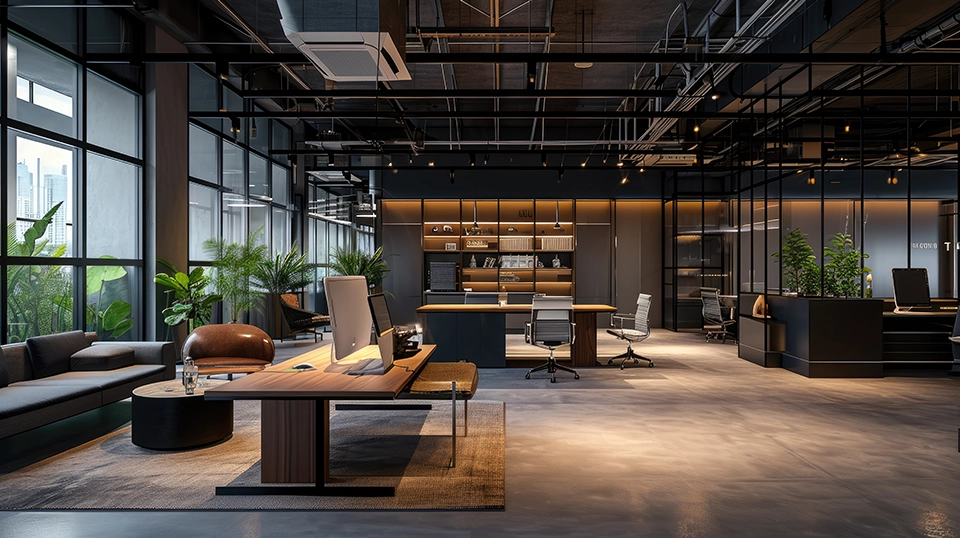
The concept of an office has undergone a radical transformation. Once defined by rows of desks, fixed cubicles, and rigid hierarchies, today’s workspaces are evolving into dynamic ecosystems that support collaboration, creativity, flexibility, and well-being. As technology advances and work cultures shift, the future of workspaces lies in smart office design—spaces that are intelligent, adaptive, and human-centric.
Modern businesses no longer ask, “How many desks do we need?”
Instead, they ask, “How can our workspace help people do their best work?”
At Morpho Dimensions, we believe that smart office design is not about adding technology for the sake of innovation. It’s about creating meaningful environments where design, technology, and human behavior intersect. This blog explores the future of workspaces and shares smart office design ideas that help modern businesses stay competitive, agile, and future-ready.

The traditional office was designed for predictability. The future office is designed for change.
With the rise of:
Hybrid work models
Remote collaboration
Project-based teams
Rapid business scaling
Workspaces must adapt in real time. Smart offices are no longer static structures; they are responsive environments that evolve with organizational needs.
A smart workspace integrates:
Technology to optimize performance
Design intelligence to improve flow and usability
Data insights to enhance decision-making
Human-centric planning to support well-being
Smart office design is not just about automation—it’s about experience.
Studies consistently show that the physical environment directly impacts productivity, focus, and job satisfaction. Smart offices reduce friction in daily tasks by:
Improving spatial efficiency
Minimizing distractions
Supporting multiple work modes
A well-designed workspace allows employees to move seamlessly between focused work, collaboration, and relaxation.
In a competitive talent market, office design has become a brand statement. Employees—especially younger generations—expect workplaces that reflect innovation, flexibility, and care for well-being.
Smart offices communicate:
Organizational values
Commitment to employee experience
Forward-thinking leadership
Smart office design uses data and modular planning to:
Reduce unused space
Adapt layouts without major renovations
Support future growth
For businesses, this means long-term cost efficiency and operational agility.
The future of workspaces starts with people. Smart offices are designed around how humans actually work—not how they’re expected to work.
Key considerations:
Ergonomics
Natural light and ventilation
Acoustic comfort
Psychological safety
At Morpho Dimensions, every design decision begins with understanding human behavior in space.
Rigid layouts are being replaced by flexible systems:
Movable partitions
Modular furniture
Multi-use zones
This allows businesses to reconfigure spaces quickly as teams, projects, or work styles change.
The smartest offices don’t feel “tech-heavy.” Instead, technology works quietly in the background to enhance experience.
Examples include:
Smart lighting that adapts to daylight
Occupancy sensors for space optimization
Seamless AV systems for hybrid meetings
One desk no longer fits all tasks. Activity-based working provides different zones for different activities:
Focus rooms for deep work
Collaboration hubs for teamwork
Informal lounges for ideation
Quiet pods for calls or reflection
This approach empowers employees to choose where and how they work best.
The future workspace must support both in-office and remote participants equally.
Smart design features include:
Video-enabled meeting rooms
Acoustic optimization for clear audio
Interactive digital boards
Flexible seating arrangements
Well-designed hybrid spaces eliminate the disconnect between physical and virtual teams.
Modern workstations are evolving beyond desks and chairs.
Smart workstation ideas:
Height-adjustable desks
Integrated power and data access
Wireless charging surfaces
Cable-free layouts
These features enhance comfort, reduce clutter, and improve workflow efficiency.
Smart offices use data to make informed design decisions:
Occupancy analytics
Space utilization tracking
Movement flow analysis
This data helps businesses understand:
Which areas are overused
Which spaces are underutilized
How layouts can be optimized
At Morpho Dimensions, data-driven design ensures every square foot delivers value.
Sustainability is no longer optional—it’s a business imperative.
Smart office sustainability strategies include:
Energy-efficient lighting and HVAC systems
Use of recycled and low-VOC materials
Biophilic design elements
Waste-reduction planning
Sustainable design not only reduces environmental impact but also improves indoor air quality and employee well-being.
Nature plays a powerful role in human productivity and mental health.
Biophilic smart office ideas:
Indoor plants and green walls
Natural textures and materials
Visual access to outdoor spaces
Water elements and natural light
These elements reduce stress, improve focus, and create emotionally engaging workspaces.
Lighting and sound are often overlooked—but they are critical to comfort.
Smart lighting:
Adjusts color temperature throughout the day
Reduces eye strain
Supports circadian rhythms
Acoustic design:
Sound-absorbing panels
Zoning to manage noise levels
Private areas for confidential work
Together, they create environments that feel calm, focused, and balanced.
Post-pandemic offices prioritize hygiene and safety without compromising design.
Touchless solutions include:
Motion-sensor lighting
Automated doors
Contactless access control
Voice-activated systems
These features enhance safety while reinforcing a modern, tech-forward image.

Smart office design is not just aesthetic—it’s strategic.
A well-planned workspace can:
Improve collaboration
Speed up decision-making
Strengthen company culture
Support innovation
Design becomes a silent partner in business success.
Your office is a physical expression of your brand.
Through:
Color palettes
Materials
Spatial hierarchy
Design language
Smart offices tell a story about who you are and where you’re going. Morpho Dimensions specializes in translating brand values into spatial experiences.
One of the biggest mistakes in smart office design is over-engineering. The goal is to enhance experience—not overwhelm users.
The best smart offices feel intuitive, not complicated.
Future work patterns will continue to evolve. Offices must be designed with:
Scalability
Reconfigurability
Long-term adaptability
This requires foresight, not just trend-following.
At Morpho Dimensions, smart office design is a holistic process.
Human-first: People before products
Context-driven: Every business is unique
Future-focused: Designed for change
Detail-oriented: From macro planning to micro experiences
Workplace strategy and research
Behavioral and spatial analysis
Concept development
Smart technology integration
Sustainable material selection
Execution and refinement
We don’t just design offices—we design workplace ecosystems.
The future of workspaces is not about predicting trends—it’s about designing for adaptability, purpose, and people. Smart office design empowers modern businesses to thrive in an ever-changing world by creating environments that support innovation, collaboration, and well-being.
At Morpho Dimensions, we believe that the smartest offices are those that evolve with their users—spaces that inspire today and adapt for tomorrow.
If your business is ready to rethink the way it works, it’s time to rethink the space it works in.
Conference rooms are no longer just enclosed boxes with long tables and static screens. In the era of hybrid teams,...
Conference rooms are no longer just enclosed boxes with long tables and static screens. In the era of hybrid teams,...
Conference rooms are no longer just enclosed boxes with long tables and static screens. In the era of hybrid teams,...
Conference rooms are no longer just enclosed boxes with long tables and static screens. In the era of hybrid teams,...
Conference rooms are no longer just enclosed boxes with long tables and static screens. In the era of hybrid teams,...
Conference rooms are no longer just enclosed boxes with long tables and static screens. In the era of hybrid teams,...